 |
firm active: 1907-1921 minneapolis, minnesota :: chicago, illinois |
 Navigation ::
Home
Navigation ::
Home
Ye Olde Grindstone
1/1/2007
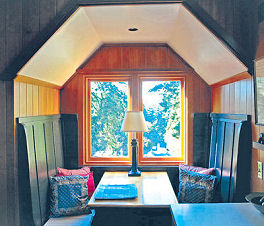
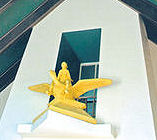
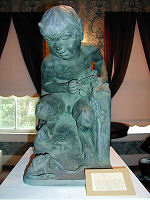
Another key element in Georgian Place is the plaster figure of "Nils the Gooseboy" (technically titled "Nils and His Goose") by Richard Bock that touches down on a small shelf parapet in the height of the chimney mass. How wonderful the thing is still in place! This is the third version of this work done by the sculptor. Purcell had seen some Bock work in a window display in Chicago and this prompted him to correspond with the artist to get something done for Lake Place in the 1910s. Bock wanted to render a "Nils" group, based on the fairy tale by Selma Lagerlf, and actually did two, keeping one for exhibition. The piece for Purcell took some time to be made, so Bock lent a smaller work, a faun, as a placeholder. The faun is what appears in The Western Architect plates and a number of the early archival photographs.
Purcell was in his forties while living in Portland. At such a point in life many people look back to earlier times for understanding and encouragement. His decision to move himself and his family to the Pacific Northwest was an effort to have a fresh beginning, and he was naturally drawn to the forest atmosphere there from his experiences as a child at Island Lake Camp. Even though he would design some fine buildings and occupy himself with speculative investments, the practice of architecture left him with time on his hands. His mind began turning toward becoming the writer whose endeavors characterized the remainder of his life. The conscious spur in this shift was indisputably the remembered example of his grandfather, W. C. Gray. A note card of this era dated July 26, 1928, sums up:
There is a post script:
Perhaps they had salmon.
The more you learn about Purcell during this time, the more you know his psychology toward life was fundamentally positive. Despite his increasing health problems, financial humiliations, family disintegration, and seeming defeat of the progressive architectural philosophy that was his fundamental cause, William Gray Purcell took these lemons and made lemonade. Art was the sweetener and writing a spoon with which he stirred. His explorations were not mere distraction from suffering, but a meaningful response. As he had done in the P&E years, through these occupations he sought to make life better for everyone. Fortunately, that group also included himself.
In the Spectacular Good News Department. This just in (and thanks to Larry and Nancy for letting it be so!): Richard Kronick, someone in the Caravan who will leave a useful legacy, travels somewhat frequently for his writing work. Recently he contacted me asking for addresses of P&E buildings in Bismarck, North Dakota, as he was going there and offered to contribute some current photographs. What an underestimation of his achievement! "Bring-'em-back-alive" Kronick has remedied an eighty year old typographical error and rectified misfiling of archival photographs of the house in the Purcell Papers. Huzzah! Turns out that two images of the dwelling appear in Images digital database are misattributed to another Bismarck residence for E. M. Thompson, which means they are misplaced in the wrong job file. A real two-fer, so congratulations, Dick! The original P&E commission list, typed in the 1910s, describes job number 120 as the Carlo Jorgenson house. As Dick pointed out, the name inclines the mind to a mongrel image that is part Italian and part Scandinavian. While that unlikely combination might have happened in New York City, perhaps even Chicago, it just seemed wrong for the plains of North Dakota in 1911. So it was. With door knocked and the way opened, we are informed that the builder of the house was "C. O. Jorgenson," which we can take to be Carl O. Jorgenson. (Dick ventures "Oscar" for the "O."). He writes thus we can attribute our windfall:
And so we have another set of hands to add to our list of P&E Team members. Welcome, Mr. Day and crew. Gertrude Phillips, the P&E Team secretary, is likely who made a boo-boo, one now forever enshrined by the University of Delaware Press in my Minnesota 1900 essay. Still, these moments are to be savored. There are no working drawings for this house, not even the slightest of sketches for this project in the Purcell Papers, but Purcell did have this to say in the Parabiographies:
In addition, Dick Kronick also sent along current photographs of the P. E. Byrne residence, where a sleeping porch is still a sleeping porch, and these will be up next time around.
All told, this update brings several dozen new pages with more than a hundred links. With that, my heartfelt thanks to all who contributed to Organica, and Organicus, in the past year. Correspondence with many of you has brought valuable information, vide above, and it is heartwarming when those who find themselves in LA make a point of visiting personally. May all of us have happy and fulfilling times in 2007. |
||||||||||||||||||||||||||||||||||||||||||||||||||

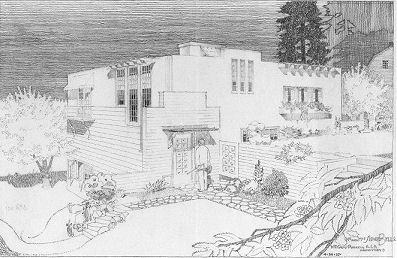


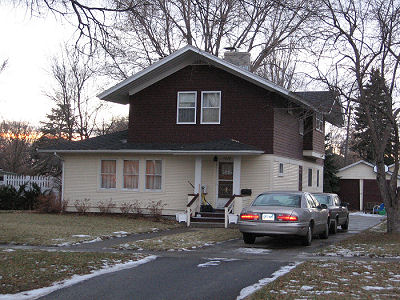
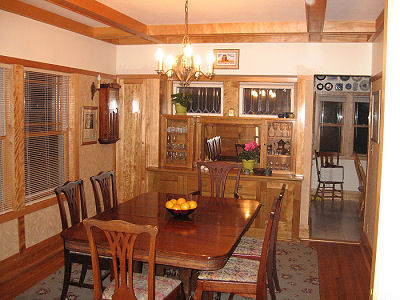

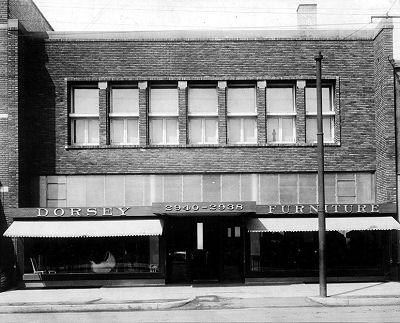

1/14/2007 Don't worry about where
we start out this time, for in quick order we are delivered to William Gray
Purcell. Maybe I am the only one surprised. Every once in a while
something happens where, after all my time in the Caravan under the tutelage
of so many fine people, I marvel that my ignorance could be even more than
usually is the case. One such instance is a
recent discovery concerning the DVD movie
The Secret Naturally, being me and
looking for freebies, I started to research the various teachers who appear
in the film and who make contributions to the book, as well as others in the
pond who were not featured in the program but who are players in what is a
burgeoning pool of self-improvement instructions called collectively the "Law of
Attraction." Turns out this whole thing has roots that go back to the
"New Thought" movement that started up in the late nineteenth century. All
this was news to me but not, apparently, to Purcell.
Just as organic philosophy
descended from the Sullivan teapot through multiple spouts (principally, of
course, with Frank Lloyd Wright and George Grant Elmslie, though there were
others) so did "New Thought" pour out in divergent directions after being
steeped with a variety of flavorings. Basically, and I simplify here to move
briskly along, the "New Thought" perspective posited the nature of the
universe as such that, at least for human beings, you receive into your life
experience what you ask by your thoughts. After that the subtleties begin,
but for the present purpose please suffer these broad strokes as background
for a point about P&E.
What eventually became the
movement called "New Thought" proceeded through other students of Quimby's and
expanded from the 1900s through the 1920s to a large herd of adherents
prolific with their pens. Along the way, the spiritually tasty writings of
the Transcendentalists, particularly Ralph Waldo Emerson (we'll be back in a
moment), and Eastern spices from Hinduism and Buddhism were infiltrated
within a scope of modern rumination that also absorbed the latest scientific
developments of subatomic particle physics, a subject we know was
also on Elmslie's bedside table.
Books proliferated, all
dedicated to the notion that the application of empirically proven
principles of thought would produce the same results of wealth, health, and
prosperity for anyone willing to make the effort. The functions of
scientific method and democratic egalitarianism were applied conceptually
together as a hinge of opportunity on which every person could turn
open the door to a better life. One of the best of the books devoted to
creating material prosperity, The Science of Getting Rich authored by
Wallace Wattles in 1910, succinctly crystallized the approach:
"There is a thinking stuff
from which all things are made, and which, in its original state, permeates,
penetrates, and fills the interspaces of the universe.
Welcome to the quantum field.
There is much to be found in the P&E design message that matches the "New
Thought" writings, just from first glance. Self-empowerment is the key to
success in life, and that arises through a neatly democratic expression of
integrity rooted in the present moment. And, to return to the
Transcendentalist influence that plays heavily throughout, Purcell also
wrote a Northwest Architect piece on Emerson, being a literary colloquy on
Beauty (January-February,
1942). Of course there are those quotes from the Transcendentalist that
appeared in "The Statics and Dynamics of
Architecture," the principal design statement for P&E published in The
Western Architect in 1913.
If you are longing for the Buddhist/Hindu son
et lumiere, there's now additional content to the Theosophical backdrop.
Contributor Richard Kronick sends note of an important article on Claude
Bragdon appearing in the December 2006 (volume 65, Number 4) issue of the
Journal of the Society of Architectural Historians. The piece is titled
"Organic Architecture and Direct Democracy: Claude Bragdon's Festivals of
Song and Light," by Jonathan Massey of Syracuse University. We won't hold
academia against him. Seems my access as an independent scholar to the Getty
Research Institute has been renewed at a critical moment, as their excellent
library collections can now be used to open an entirely new front of study
unto mine eyes. First, I think I need to stop in more often in the magazines
area!
Aside from Christian Science,
we know that Purcell was familiar with this stream of literature for another
reason. One of the more famous "New Thought" texts is Acres of Diamonds,
by Russell Conwell. Purcell actually devoted a whole piece to the message of
this book in a Northwest
Architect article published in the September-October,
1941 issue, tuning the ideas toward the salesmanship of the architect. I'll
bet there is more to be uncovered, and I am on the trail. How nice that the
side effect is to make me more effective in my own prosperity. In the works,
see next.
Loyal correspondents have learned by now that, in order to stabilize my life
after nearly eighteen months of uneasiness and uncertainty following my
little reminder of mortality in August, 2005, I have resumed working for an
architecture firm in order to avoid another eviction notice and the regular
threat of utility cutoff. I have also started serious work on my retirement
fund--er, first novel. Add to that my geeky pastime of transitioning the
HyperFind code base into the .NET architecture. This past Grind has
generated more fan mail than any other, and I note that it took the better
part of two holiday weeks to get up. There is an issue here of quality over
quantity. I do add materials to the site, fix links, etc., often during the
week, and the Grinds used to consist of an account of just that in the very
beginning. But no one has sent email saying how much they enjoyed reading
about keystrokes. I have found that the Grinds work best on a regular
schedule. The question is how often can I produce something worthwhile.
Even though a crowd of twelve people have
voted in one or another of the P&E polls, I decided to create one to
determine the content and frequency of the Grinds. So, for those who care,
here are the options. Voting will be held open until the first of February.
If you are reading this, please click through and let me know what's your
pleasure. The server logs show there are two hundred monthly readers of the
Grind. Let's see how many vote. Next
update planned for 1 February 2007, when the poll gets decided.
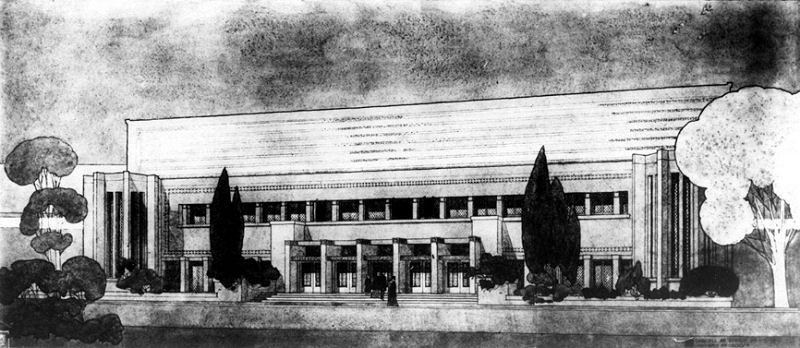
Presentation rendering (original
is colored pencil on art board)
Third Church of Christ,
Scientist, project
Purcell and Elmslie
Minneapolis, Minnesota
1914
New Thoughts for Old.
This will be brief, something of a side
car.
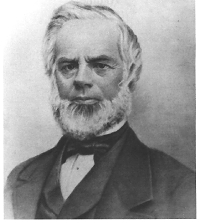
Phineas Parkhurst Quimby
Source: Wikipedia (public domain)What came to be called "New
Thought" trickled, and sometimes gushed, down from intellections rendered by a Maine
Yankee named Phineas Parkhurst Quimby
(1802-1866). A mesmerist healer "neither an allopathic physician or a medium," he had patients to impress with his beliefs. One of
these was
Mary Baker Eddy (1821-1910). Although there are nits to pick about
the degree of influence, Eddy iterated experiences absorbed through her
exposure to Quimby in founding the Christian Science Church. Eventually,
Eddy considered Christian
Science not to be "New Thought," per se, however much the
connection with Quimby throws a shadow. Still, whatever disputes historians
may have about Eddy or Quimby being first to own a wagon, there was
historical involvement between them on a personal basis and they both sold
milk from the same dairy, so to speak.
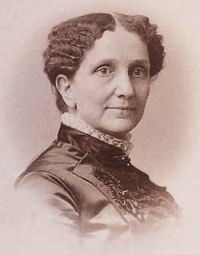
Mary Baker Eddy
Source: Wikipedia (public
domain)
This connection forms the first but not the only link of relevance to Purcell. Despite
having the traditional Christian background of his influential Presbyterian
grandfather, W. C. Gray (1830-1901), Purcell entered the Christian Science
realm through marriage to his first wife, Edna Summy Purcell (as
noted in the previous Grind). He remained involved with the organization
until the 1930s, pursuing architectural commissions for these assemblies as
well as writing for The Christian Science Monitor and jousting in
correspondence with the paper's editor, Willis J. Abbott, in a thinly veiled
effort to use the publication as a forum for the flagging organic cause.
A thought, in this substance, produces the thing that is imaged by the
thought.
Man can form things in his thought, and, by impressing his thought upon
formless substance, can cause the thing he thinks about to be created."
[end of Chapter 4. The
electronic copy I have lacks pagination]

My blog is worth $0.00.
How much is your blog worth?
Tiny
Something
Department. Since my hobby in life has turned out to be information
architecture, I read widely on the net. Sometimes links show up from nowhere
that lead somewhere. The illustration to the left is a result of a such a
sideclick in response the obvious question, "How much is my blog worth?"
This is a little applet that uses some research datasets to weight
readership. I leave it to the fair readers of this blog to determine what
value is received for time spent. This, and the fact that after being asked
to put up a donation button it still has the same total as the blog, keeps
me honest in a labor of love, I guess. However.
 research courtesy mark hammons